How People Showed Their Skills Before Portfolios
See how people showed skills before portfolios through objects, demonstrations, performances, and recommendations—and what each kind of evidence could reveal.
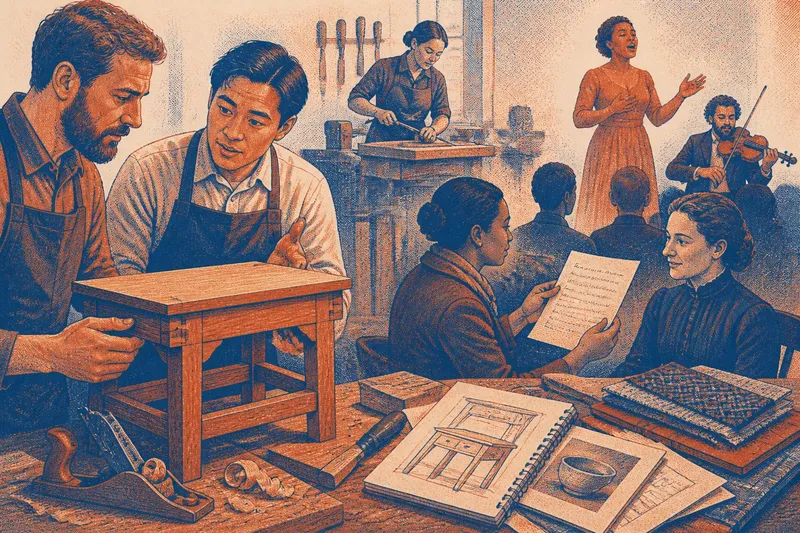
The common mistake in asking how people showed skills before portfolios is to imagine a single older system that worked the same way everywhere. That can turn a varied set of encounters into an unsupported historical story. A clearer answer stays with the kinds of evidence people can recognize: finished work, demonstrations, performances, recommendations, and repeated contributions.
Finished work gave viewers something tangible to inspect
A chair, a woven cloth, a tool, or a carefully copied page could make choices about materials, proportion, finish, and function visible. Someone could examine the object closely and, where appropriate, handle it or compare its parts.
The object could not explain its own making. A polished result might leave questions about assistance, the use of a model, or the maker’s decisions along the way. Asking the maker to describe one choice can add context without diminishing the work itself.
Imagine a cabinetmaker bringing a small table to a prospective patron. The patron inspects its joints, then asks how the maker handled a difficult piece of wood; the table provides tangible evidence, and the answer clarifies the maker’s process.
Live demonstrations made choices visible in the moment
In a workshop, studio, kitchen, or other place of skilled work, someone could show a technique while an observer watched. The observer might notice the order of actions, a tool adjustment, or how the worker responded when a material behaved unexpectedly.
A demonstration also reflects its setting. Familiar tools and a suitable workspace may let someone work comfortably, while an unfamiliar room or an audience can change the experience. What a viewer sees is useful evidence about that task in those conditions, not a complete account of every skill.
The observer’s attention matters. Someone who knows the work can ask about a decision or notice a careful adjustment; someone focused only on speed may miss it. Describing what was observed is more useful than relying on a general impression.
Performance showed timing, expression, and response
For singers, actors, speakers, and instrumentalists, a live performance could reveal timing, expression, and response to other people. The audience experienced the work as it unfolded rather than inspecting a finished object afterward.
Performance conditions shape what becomes visible. A quiet rehearsal, an audition, and a group performance ask different things of a person, so a single showing should not stand in for every setting.
A viewer can make observations more specific by listening for a steady rhythm, an intentional phrase, or an adjustment when another musician changes pace. Those details say more about the work than simply deciding that the performer seemed confident.
Recommendations offered another person’s judgment
A teacher, craftsperson, employer, or community member could describe someone’s work and approach to responsibility. A recommendation gave the recipient a starting point, but it remained an account from another person rather than direct access to every skill.
Its usefulness depends on what the recommender actually observed. A specific description of a person’s contribution carries more information than broad praise, while relationships and access can affect whose work is introduced.
A viewer can ask what the person did, which parts the recommender saw directly, and what conditions shaped the work. Those questions keep the recommendation in proportion while making room for the knowledge behind it.
Repeated contributions revealed patterns over time
Some abilities appeared through ordinary participation rather than a special presentation. Repairing equipment, preparing a shared workspace, or contributing to group work could make care and attention visible to people nearby.
Repeated observation is not automatically fair. Quiet contributions may be missed, and an observer may continue to rely on an old impression even after someone’s skills change. Naming the action and its context helps keep a judgment grounded.
Imagine an apprentice who rarely speaks in a group meeting but regularly spots a flaw in a drawing before production. A colleague who notes the specific correction can explain the apprentice’s contribution more clearly than calling them “naturally sharp.”
Portfolios gathered evidence that people could revisit
A portfolio collects examples so a viewer can return to them, compare pieces, and notice different interests or approaches. It might include drawings, writing, photographs of objects, recordings, or notes about a project, making selected work easier to share across places.
Selection shapes what the collection communicates. It may favor finished pieces over drafts, visual work over less visible contributions, or projects that photograph well over work that depends on sound, touch, or collaboration. Captions can explain the purpose of a piece, the maker’s role, and the choices worth noticing.
A portfolio is a selected record, not a neutral account. A reader can appreciate what is present and ask what kinds of work or context the collection leaves out.
Which kind of evidence answers your question?
What does an in-person demonstration reveal?
It can show technique, decisions, and responses to a task in a particular setting. It cannot show every ability or how someone works under different conditions.
What can a portfolio show that a live encounter cannot?
A portfolio lets a viewer revisit examples and compare work made for different purposes. Its selection may still omit process or context, so captions and conversation can help.
How can a viewer account for collaboration?
Ask what the person contributed, which decisions they made, and where others helped shape the result. A shared project can show the group’s work without making each person’s role obvious.
Is one format better for judging ability?
Neither format captures every part of a person’s capability. Choose evidence that fits the skill and question at hand, then note what that evidence cannot show.
Read each kind of evidence for what it can show
These forms of evidence answer different questions rather than lining up in a simple progression. An object invites close inspection; a demonstration reveals choices in motion; a performance makes timing and response audible or visible; a recommendation offers someone else’s account; repeated work can reveal patterns; and a portfolio makes selected examples easier to revisit.
When considering how people showed skills before portfolios, keep the setting and the observer in view. A person’s ability may be easier to recognize when the evidence suits the work and the viewer knows what to notice.
When reviewing a portfolio or watching someone work, ask what the evidence shows, what it leaves out, and what would clarify the person’s contribution. A brief conversation about the task and the choices behind it can make the evidence easier to understand.